
Public cloud cost management in Yarken: See past the bill. Track the value.
Public cloud cost management in Yarken: See past the bill. Track the value.
Scope series. Public Cloud is the first scope FinOps formally recognized. This post is about what supporting it actually means inside one operating model, not as a standalone tool.
There is a moment, usually a year or two into a FinOps program, when the CFO asks a question that public cloud cost management is not set up to answer.
"What does cloud cost the e-commerce business unit, fully loaded? How does cloud TCO compare to the on-prem footprint it was meant to replace? Why is the Platform team's monthly forecast missing by 15 percent?"
The answers exist. They live in different systems, on different cadences, with different owners. AWS Cost Explorer covers one provider. Azure Cost Management covers another. The labor sits in HR. The license sits in a contracts folder. Allocation to business units happens in a quarterly spreadsheet that takes a week to reconcile and never quite ties out.
That is typically where time, money, and accuracy start leaking. An analyst spends most of a week stitching together the bill, the license, the labor, and the allocation. Commitments expire without being reattributed. Forecasts miss because the people closest to the workloads are not the ones doing the forecasting. The FinOps Foundation Scopes framing names this gap honestly: Public Cloud is one scope, but the cost of running on it is shaped by license, labor, and business outcomes that sit outside the bill.
The problem isn't visibility into public cloud spend. Native consoles solve visibility. The problem is that public cloud cost typically lives in a different system, on a different cadence, with a different owner, and never reconciles cleanly with the rest of the IT estate, or with the business it supports. Often, the bill is the only thing measured. The license, the labor, and the business outcome sit elsewhere, or nowhere.
Public cloud cost management is not a separate program, it's part of the same model
In the Yarken model, cloud usage data flows in through cloud provider native integrations from AWS, Azure, GCP, and others, and lands inside the same TBM hierarchy that holds everything else: cost pools, towers, solutions, applications, business capabilities, business units. Cloud TCO is one lens on the Platform module, alongside Server TCO, Mainframe TCO, and On-Prem TCO. The Spend Model Sankey shows cloud cost moving through the same allocation rules as labor and license.
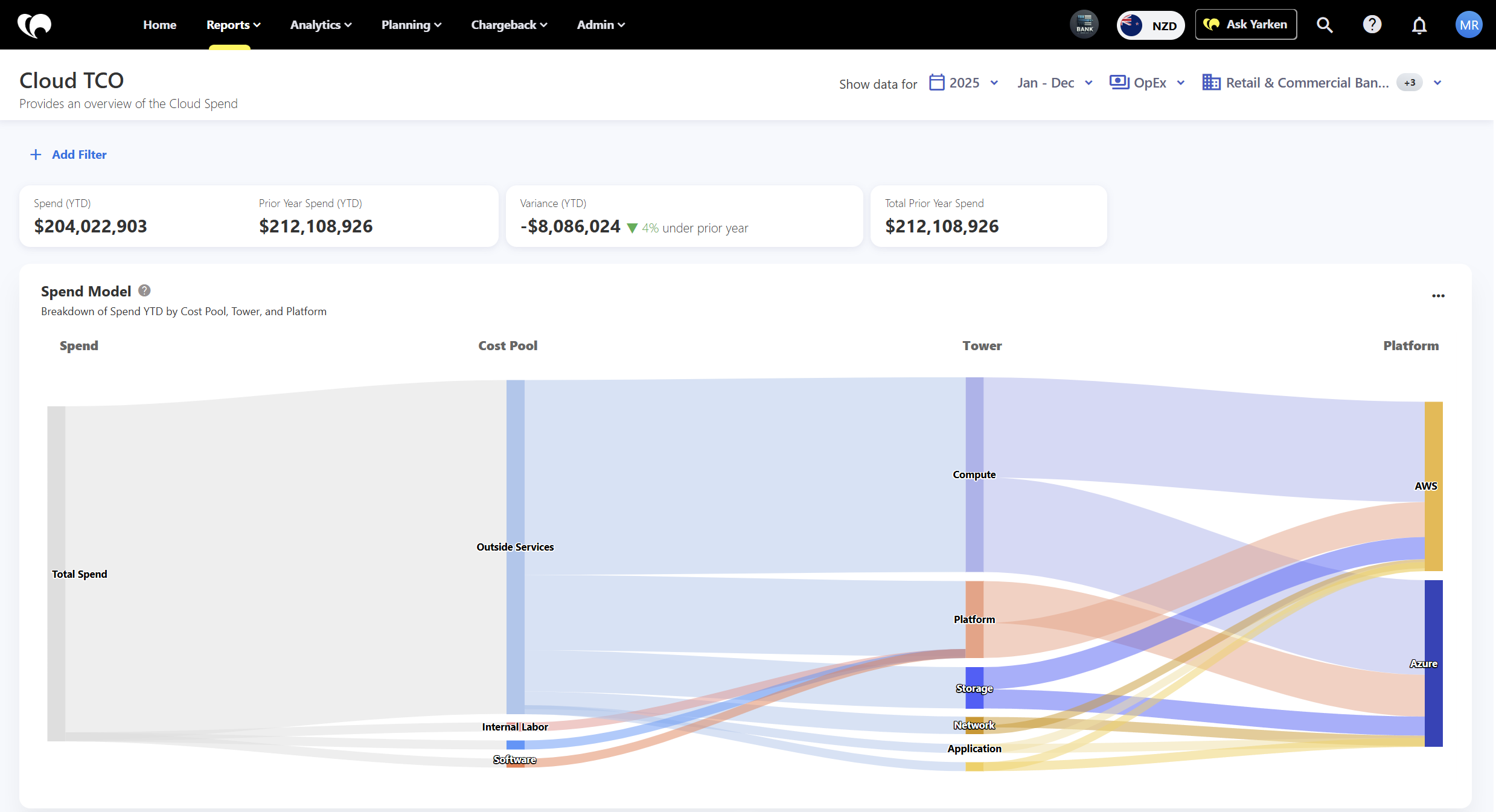
The inheritance matters as much as the data. Public cloud uses the same budget workflow as the rest of IT. The same forecast cycle. The same RAG status reports. The same chargeback engine. Team-based cloud forecasting puts the forecast in the hands of the team driving the spend, with Forecast Activity Logs, Accuracy Trend, and Team Showback feeding the same dashboards a CFO opens on Monday. It is not a second tool to learn. It is one operating model with a cloud lens turned on.
That, in practice, is what multi-cloud FinOps looks like when it stops being a side project.
What this looks like in practice
Take an illustrative example. A retail company runs production on AWS and analytics on Azure, with a smaller GCP footprint for a specific data product. The FinOps team runs a monthly forecast cycle. The CIO has asked for full cloud TCO at the business-unit level, not just billed cost.
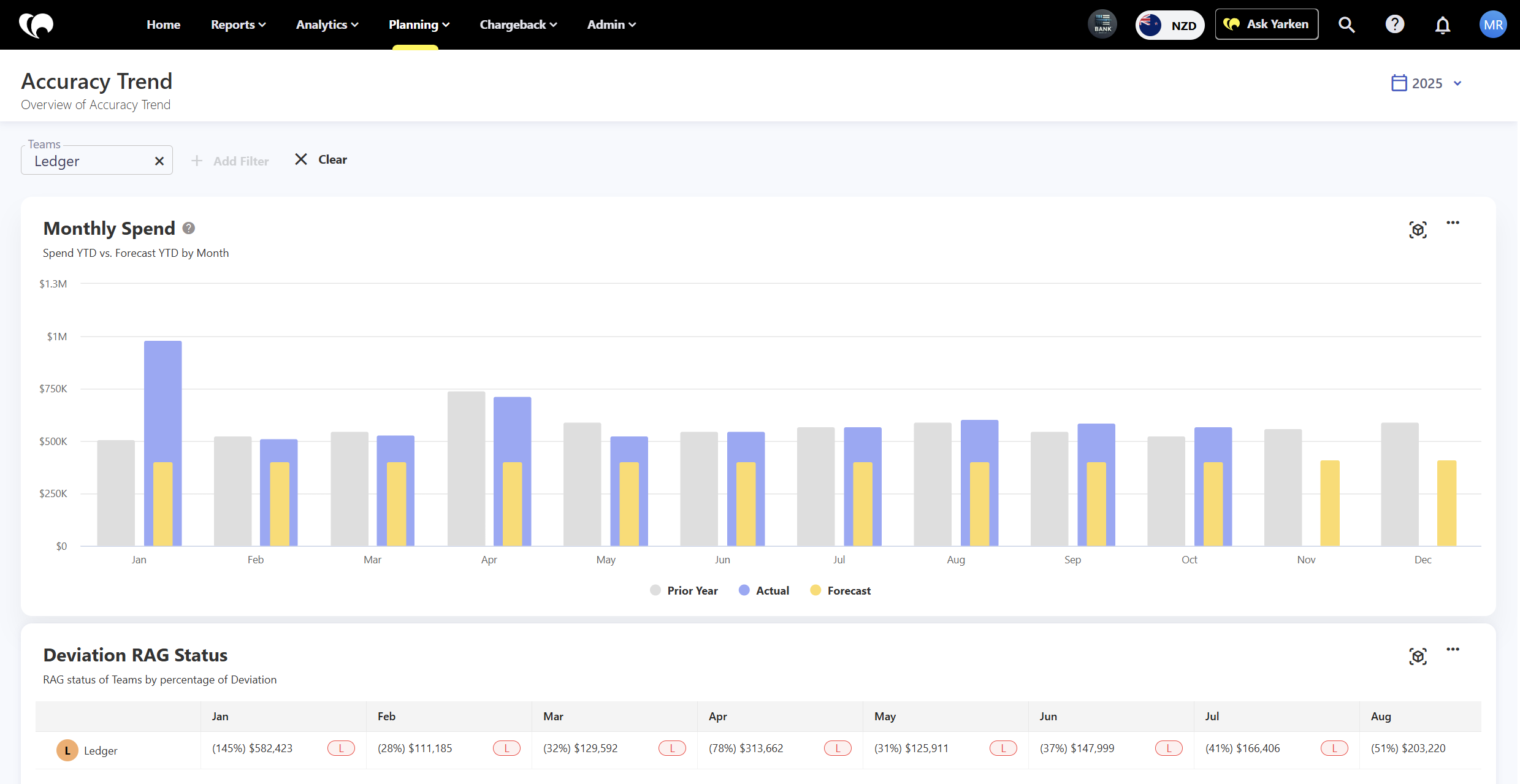
Team Forecast page showing monthly forecast vs actuals with RAG indicators, alongside Accuracy Trend across teams.
Without and with
- Native consoles handle visibility per provider. A spreadsheet handles the mashup.
- Forecasts sit in a separate tool, owned by FinOps, not by the teams doing the spending.
- License cost lives in a contracts folder, mostly invisible from cloud reports.
- Labor for the cloud platform team lives in HR or finance, never aligned to workloads.
- Chargeback to business units happens quarterly, after a reconciliation that takes a week.
- Cloud bills land via cloud provider native integrations across AWS, Azure, and GCP, in the same model as everything else.
- Team-based cloud forecasting puts the forecast on the teams that drive the spend.
- License cost flows into cloud TCO, mapped to the same platforms and applications.
- Labor allocates against the workloads the team runs, so TCO reflects what is actually being spent.
- Chargeback runs continuously from the published model, with the same approval flow as the rest of IT.
Key things to know
Native Integrations
Cloud provider native integrations cover the major providers. AWS, Azure, and GCP flow in directly.
Team Forecast
Team Forecast is its own input layer. Teams own the forecast, while FinOps owns the cycle.
Broader Cloud TCO
Cloud TCO is broader than the bill. It rolls cloud-related license and labor cost into the exact same view.
Unified Platform Lens
Cloud sits inside the same Platform TCO lens. Cloud TCO, Server TCO, and On-Prem TCO line up side by side.
Inherited Chargeback
Chargeback and showback inherit from the same model. Business Unit Chargeback and Showback expose what cloud actually costs each BU.
See past the bill. Track the value.
Public cloud cost management in Yarken is the bill, the license, the labor, and the business unit, in one model.