
AI cost management in Yarken: see every dollar. Defend every investment.
AI cost management is the newest scope FinOps now formally recognizes. Here is what supporting it actually means inside one operating model.
Six months into a serious AI investment program, the AI cost management question lands on the FinOps lead. What did we spend on AI last quarter, and what did it buy us?
The first half is built across three weeks of stitching. The Bedrock line on the cloud bill. The Anthropic invoice from procurement. The Microsoft Copilot SKU inside the existing EA. The Salesforce Agentforce add-on on the Service Cloud renewal. The on-prem GPU cluster depreciation schedule sitting in five GL accounts. The ChatGPT Plus reimbursements on the P-card report. By the time the spreadsheet ties, the answer is wrong. Two new SaaS AI add-ons turned on inside Marketing last week.
The second half is harder. Pilots ran on free credits. Production hit with retraining, retrieval overhead, governance logging, and human review. The cost story arrived six months after the business case was funded, with no record of what the gate was told to expect. Outcomes get tracked anecdotally if at all.
The visible cost is the spreadsheet. The deeper cost is CFO confidence that closes the door on the next AI investment conversation.
Look at how an enterprise allocates cloud. A FinOps lead opens the FOCUS-formatted bill, tags resources, allocates by usage telemetry. Now look at how the same enterprise allocates AI. The bills arrive on different days in different units against different contract structures, and the closest thing to one number is the spreadsheet the finance team built by hand. Hyperscalers publish their GPU rates. Vendors publish their token rates. The pricing surface is concrete. What sits on top of it, who used it, what product it served, which business case it was funded against, that surface is anecdotal.
Pricing is the easy half. The harder half is attribution. AI cost management is the newest of the FinOps Scopes the FinOps Foundation formally recognizes, and the discipline of doing it at enterprise scale is what the industry now calls FinOps for AI.
AI cost management is the same TBM model with five new inputs
Yarken AI Economics is a module on the Yarken TBM and FinOps platform. It pulls every AI dollar into one defensible view, attributes each dollar to the team and the business outcome it serves, and tracks whether each AI investment delivered what the business case said it would.
Five cost categories ingest into the same TBM model. Cloud AI compute through FOCUS connectors. Detailed AI metrics via API integrations (Azure OpenAI, Azure ML, AI Search, Document Intelligence, AWS Bedrock, Vertex). LLM API tokens through provider API integrations on OpenAI, Anthropic, and Google, with the per-rate detail intact across cached input, non-cached input, output, and reasoning. AI software licenses through GL expense rows (Microsoft 365 Copilot, Salesforce Agentforce, ServiceNow Now Assist, DataRobot, Scale AI, GitHub Copilot, the long tail). AI development labor through GL, internal headcount and contractors split by employee against the Solution Offering they support. AI vendor contracts through GL, covering AI consulting and managed services, including the vendor invoices that get reclassified at audit. Detailed AI metrics, tokens, inference counts, agent interactions, seat utilization, retrieval volume, land through the same API integrations alongside the financial spend, attached to the same Solution Offering as the dollar that generated them. On-prem GPU CapEx and OpEx folds into the compute category through the asset register; shadow AI on P-cards surfaces through the expense feed into the licenses category with its sourcing flag intact.
The canonical entity is the Solution Offering, an existing object in the TBM taxonomy. Every AI agent, application, and service attaches to a Solution Offering. The cost, the consumption metrics, and the business case all sit on the same entity. The drill is business action, then model, then trace. The roll-up is Solution Offering, then Service, then Application: the same hierarchy AI chargeback already reads from.
AI runs on the existing TBM taxonomy with five new input streams, mapped through the same allocation engine that handles cloud and on-prem, reported through the same Bill of IT.
What this looks like in practice
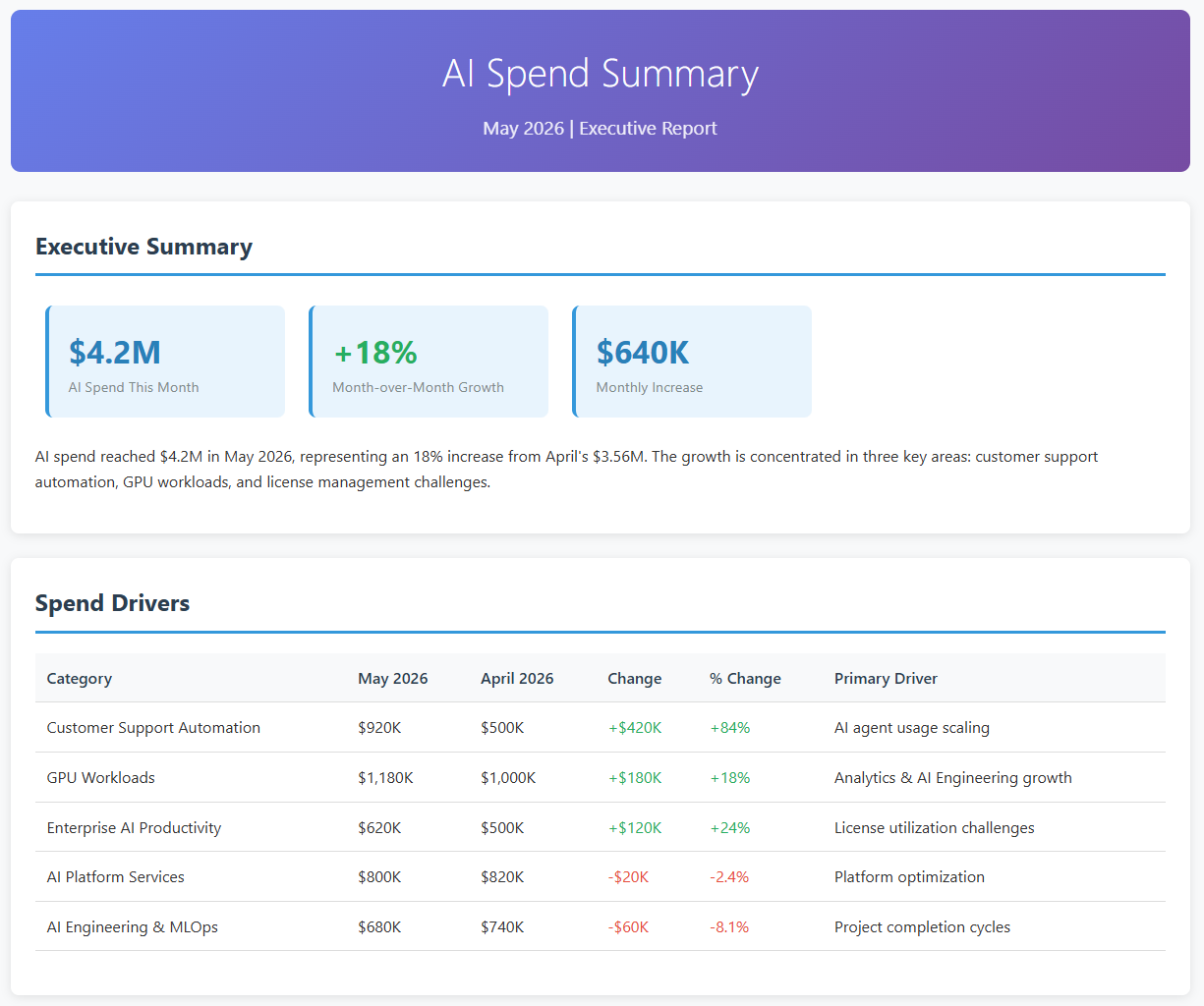
Take an illustrative example. A midsize technology company, twelve AI applications in production, eighteen AI vendors under management. May 2026 AI spend closes at $4.2M, up 18% on April's $3.56M. AI now runs at 8.4% of the IT budget. The CFO has two questions before the board pack goes out. Where did the $640K of additional spend come from. What did it buy.
Five categories land in the model:
The team view rolls the same dollars by Consumer. Customer Support runs at $1.5M for May, up $420K on April. Analytics at $800K, up $180K. Engineering at $700K, up $120K. Sales Ops at $300K, up $55K. Corporate IT and shared at $900K, down $135K.
The $640K month-over-month rise traces back to three real drivers and one reclassification. Customer Support agent usage up 34%, dragging its Azure OpenAI token consumption with it. Total Azure OpenAI token volume up 21%, 170 billion tokens in May against 140 billion in April. GPU workload up in the Analytics team, hitting cloud AI compute. And one vendor invoice reclassified from generic consulting to AI consulting, which lifted the AI vendor contracts line without being new spend.
Alongside the drivers, the same screen flags a separate waste signal. Microsoft 365 Copilot seat utilization slipped from 64% to 61%, with $35K of unused seat cost in May against $32K in April. The Copilot line is roughly flat month-over-month, so it does not show up as a driver of the cost rise. It shows up as ROI worth a renewal conversation before the next true-up.
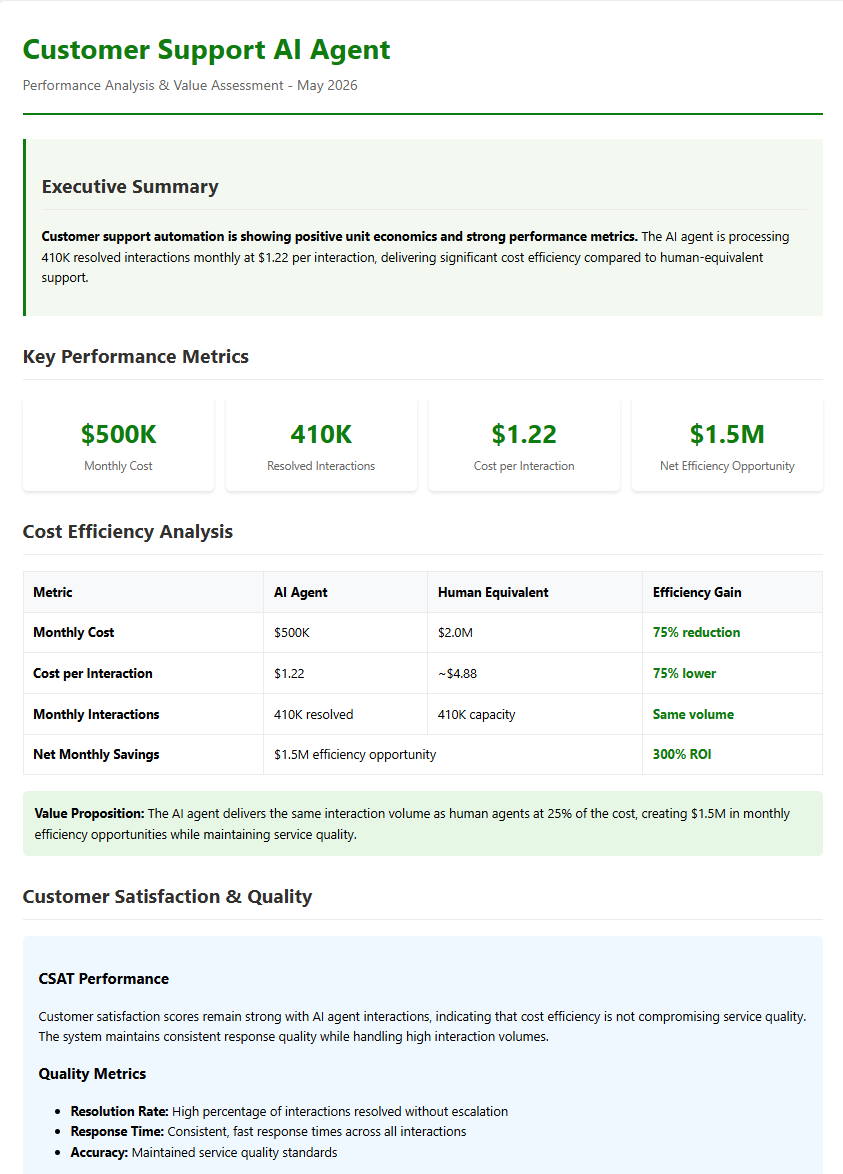
The application-level view drills further. The Customer Support AI Agent runs at $500K, resolves 410K interactions in May at $1.22 each, against a human-equivalent cost of roughly $2M. Net efficiency of $1.5M, on a Companion Metric trend that improved from $1.27 per interaction in April. The Internal Knowledge Assistant costs $180K against 187 monthly active users on 2,000 licensed seats. Adoption at 9.4%. The standing recommendation is to review before expanding seats.
When an agentic workflow burns four times its weekly average on a Friday because a retry storm hits a flaky tool, daily anomaly detection catches it Friday morning. The flag carries the application, the model, the business action, and the dollar delta on the same alert. The retry storm gets caught before month-end close.
Once a month, the AI initiative business review pulls every initiative onto one page. Projected cost. Actual cost. Projected outcome. Actual outcome. Vendor mix on strategy. The monthly cadence is what closes the loop between funding gate and outcome.
Without and with
Without AI scope support in your platform:
- Multiple AI bills live in multiple places, in multiple units, with multiple owners. The rollup happens by hand, in a spreadsheet that ages within a week.
- AI initiatives get funded against business cases nobody tracks actuals against.
- True-ups arrive as surprise invoices six to nine months after the consumption.
- Shadow AI on P-cards stays invisible because no single vendor sits above the vendor-consolidation threshold.
- The CFO has the bill, not the value story. The next AI investment conversation gets harder.
With Yarken AI Economics:
- Every AI dollar attaches to a Solution Offering through the same TBM taxonomy the rest of the IT estate runs on.
- Time to first defensible AI TCO number, contract to live view, is roughly three weeks.
- Business cases track projected cost, projected outcome, and actuals on the same screen.
- Daily anomaly detection catches retry storms and reasoning-depth spikes before they become invoice incidents.
- The monthly AI initiative business review puts cost, value, and vendor mix on one operating model for the CFO.
Six months from now, the question lands again. Two more AI add-ons have turned on inside Marketing. The LLM rate card has shifted twice. The vendor list is longer. The model that handles the bill today is the model that handles it then.
See every AI dollar.
Control every AI investment.