Identify the full cost base
Bring together GL, cloud, contracts, invoices, labor, project, and usage data.

AI Economics
See every dollar. Control every investment.
Yarken connects AI Usage, Spend and Ownership to Business Value. One financial model, so every AI dollar can be allocated, governed, and tied to a business outcome.
AI capitalization
AI development costs sit across cloud services, model APIs, software, internal labor, contractors, data, and specialist vendors. Yarken brings those costs into one governed model and connects them to the products, initiatives, owners, and development stages that created them.
Bring together GL, cloud, contracts, invoices, labor, project, and usage data.
Allocate spend to products, initiatives, teams, applications, and business units.
Maintain a consistent financial record that supports capitalization assessment, governance, forecasting, and audit preparation.
Ask Yarken
Ask the question behind the dashboard. Yarken applies your financial model, business context, and operating rules to explain what changed, why it changed, and what should happen next.
Talk to an expert01
Bedrock, Azure OpenAI, Vertex AI, GPUs, and specialist infrastructure.
02
OpenAI, Anthropic, Google, Cohere, and other model providers.
03
Copilot, Agentforce, Now Assist, Cursor, and AI-enabled SaaS.
04
Internal teams, contractors, labeling, training, and operations.
05
Consulting, existing SaaS licences, AI data licences and specialist AI tools.
The problem
Cloud shows one slice. The full cost of AI now sits across five disconnected categories, owned by different teams and measured in different ways.
Cloud bills show one. Yarken brings all five together.
Governed AI Economics
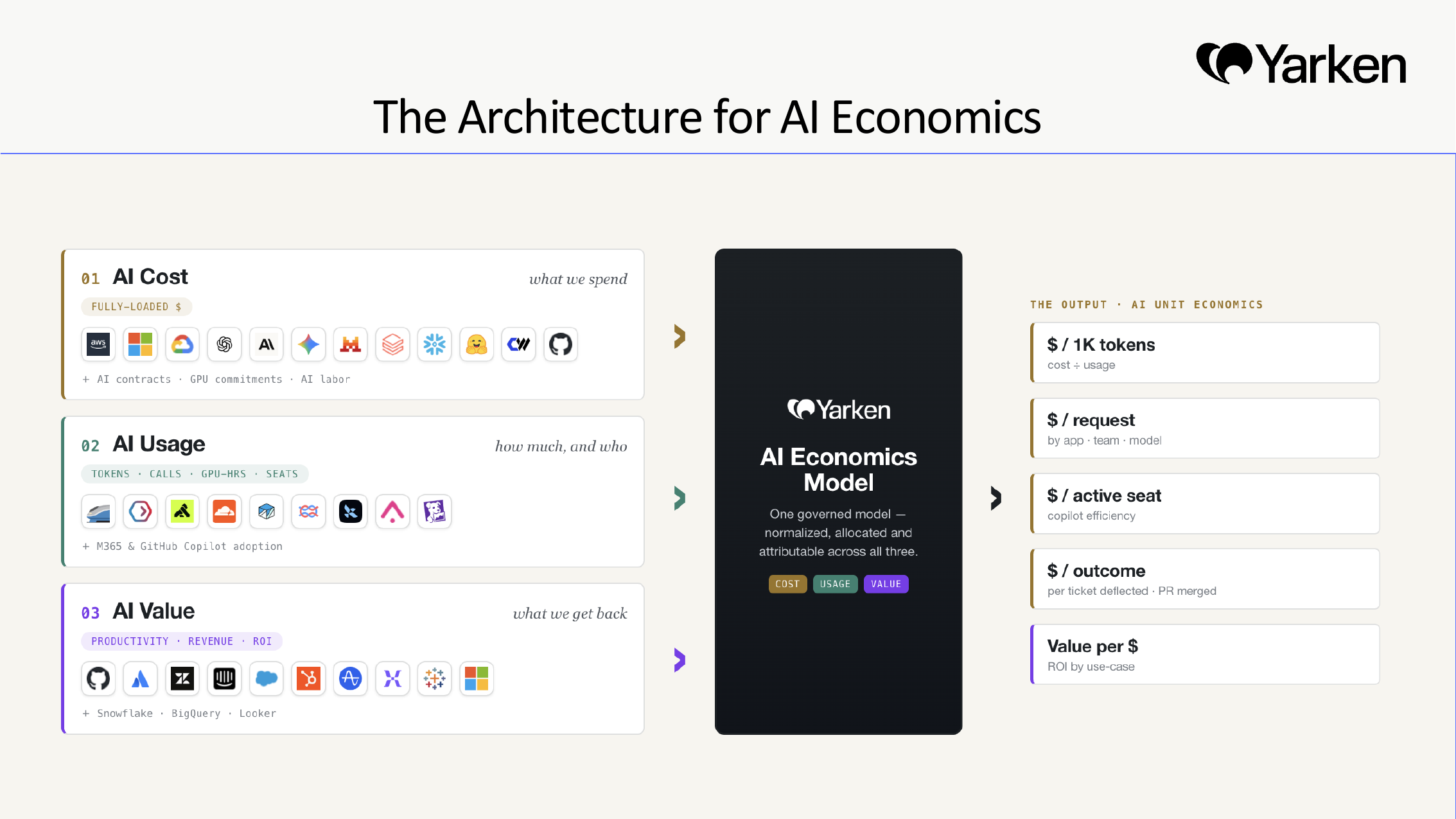
Bring fragmented AI Economics into one governed system to understand AI Spend versus Business Value.
Build a fully loaded view across compute, tokens, licenses, contracts, labor, and data.
Understand adoption and consumption across models, workloads, teams, seats, calls, and GPU hours.
Connect AI investment to productivity, revenue, efficiency, quality, and business outcomes.
Decision-ready AI unit economics
How it works
Bring fragmented AI Economics into one governed system to understand AI Spend versus Business Value
Bring together cloud cost, APIs, SaaS, contracts, GL, labor, invoices, and usage data.
Normalize spend into a governed TBM and FinOps-aligned model.
Assign cost to apps, services, teams, initiatives, and business units.
Track budget forecasts, variances, showback, cross-charges and unit economics.
Platform capabilities
Move from fragmented cost visibility to governed AI economics across leadership, finance, engineering, and FinOps teams.
See ownership, classification, concentration, production status, and activity outside approved channels.
Use explainable suggestions and governed rules to map fragmented spend to accountable owners and outcomes.
Understand cost by squad, member, model, environment, technology tower, and use case.
Build governed specialist agents and playbooks that assist execution while keeping people in control.
Ask questions in natural language and receive a structured observation, root cause, and recommendation.
Track AI spend against budget, project year-end run rate, and connect investment to realized business value.
Yarken AI Studio
Yarken brings domain-focused AI specialists into technology finance workflows. Start with a library built around common enterprise needs, then configure specialists, skills, tools, and playbooks to fit your organization's financial model and processes.
Explore Yarken AI Studio →01Start with the library
02Configure to fit
03Run on your model
What it helps with
Investigate cloud and AI spend.
What it helps with
Explain cost drivers and budget movement.
What it helps with
Review vendor spend, contracts, and renewals.
What it helps with
Improve mapping quality and cost allocation.
Governance outcomes
Yarken connects spend to ownership, ownership to business context, and business context to action.
AI Economics packages
Start with cost visibility, govern usage and ownership, and connect AI investment to business value.
See and control AI cost.
Best for
Teams that need one trusted view of AI spend before it gets out of control.
Custom pricing and implementation options available.
Govern usage, ownership and forecast.
Best for
Organizations that need to understand who is using AI, where it's being used, forecast budgets, and where governance gaps exist.
Custom pricing and implementation options available.
Connect AI investment to value.
Best for
Leaders who need to connect AI investment to business value, capitalization, and financial accountability.
Custom pricing and implementation options available.
Also available as 3rd-party integrations (not included in any package): intelligent model routing, token and context efficiency optimization, and developer experience & integrations.
Yarken is live with enterprise technology teams governing complex spend across cloud, SaaS, infrastructure, labor, applications, and AI.






SOC 2 compliant, FinOps Certified, aligned with the TBM Council, a member of Tokenomics Foundation, and recognized by Gartner as an established ITFM vendor.


.svg)

Yarken combines cost intelligence, planning, contracts, application TCO, showback, chargeback, FinOps, and AI Economics in one governed platform.
Talk to Yarken
If AI costs are growing faster than your ability to explain them, Yarken can help. We connect AI usage, spend, ownership, and value in one governed financial model.
Tell us what you are trying to understand. We will follow up with the right Yarken specialist.