
There's a meeting most technology leaders have sat in.
Someone asks why IT spend is up. Three people in the room give three different answers, each correct, each from a different view of the same cost. Finance sees allocated budgets. Engineering sees resource consumption. The CIO sees something in between that doesn't quite match either.
Nobody is wrong. But nobody can move forward until the views align. And aligning them takes time nobody has.
This is the problem that hasn't changed, despite years of TBM implementations, FinOps practices, and cost visibility tools. The data exists. The issue is that financial structure and operational detail live in separate contexts, and every time something changes, they have to be manually connected.
So, when a cost spikes, or usage shifts, or a budget is questioned, you don't move to action. You move to reconciliation. You ask: does this match finance? Does this map to how we report? Are we even looking at the same thing?
That's where time gets lost. Not in finding the data. In connecting it.
At Yarken, we built a single system where that connection is native, not assembled after the fact. Financial structure stays intact. Operational detail is fully available. And both exist in the same context, at the same time.
What that looks like in practice:
You start from a board-level question, what does this application cost the business and move directly through service cost, IT towers and cost pools, aligned to accounts, cost centres and vendors, all the way down to server metering, cloud consumption records and labour timesheets.
One path. No tool switching. No rebuilding context.
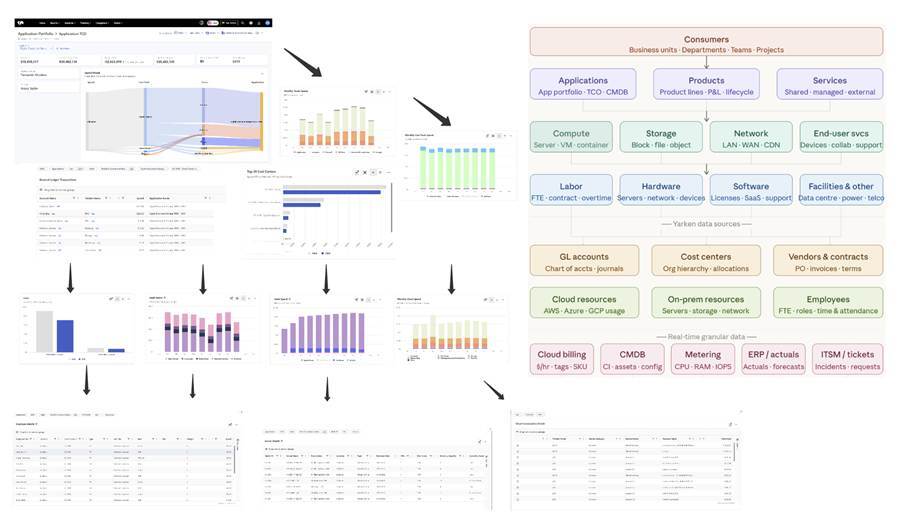
(Image: the Yarken drill-down from Application TCO to granular resource data)
This is what we mean by unified. Not a new framework layered on top of existing ones. A practical way to make financial and operational views of cost work together, so that when something changes, you're not asking which view is right. You're already looking at both.
The goal was never better reporting. It was always faster, more confident decisions.
Next: how this model connects into the rest of the enterprise without disrupting how teams already work.
