
What AI-First Companies Are Actually Thinking About Cost Management
There is a gap opening up inside AI-first organizations right now. They can see the spend. They cannot see what it's producing.
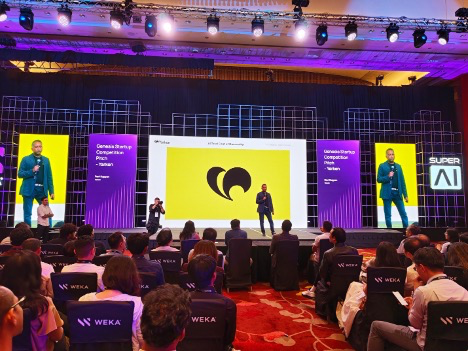
At SuperAI 2026 in Singapore, we spent two days on the floor talking with founders, engineers, data platform leads, and technology executives from some of the most AI-forward companies in the world. The conversations were not about whether AI is expensive. Everyone already knows that.
The conversations were about something harder: what do you do when the cost is real, growing fast, and you cannot clearly explain what it is producing?
This blog captures what we heard. Not the keynote version of AI economics, but the ground-level reality from teams actively managing AI spend at scale.
If your organization is increasing its AI investment in 2026, this is where your peers are right now.
What Is AI Economics, and Why Does It Matter Now?
AI Economics is the practice of connecting AI spending to measurable business outcomes. It goes beyond tracking token consumption or inference costs to answer the deeper question: is this AI investment generating proportionate value for the business?
At its core, AI Economics means treating AI spend the same way a CFO treats any other capital investment. You want to know what you spent, who consumed it, what it produced, and whether the return justified the cost.
Most organizations can answer the first two questions today. Very few can answer the third and fourth. That gap is where the pressure is building.
Why Token Governance Became the Entry Point
The conversations at SuperAI were not about slowing AI down. Every organization in the room was still firmly in enablement mode, asking how to do more with AI, faster. Nobody was talking about guardrails.
This is not a niche concern. Across the companies we spoke with, the pattern was consistent. AI adoption starts with a small number of use cases, managed informally. Then it scales. Developer teams start using model APIs independently. Product teams spin up inference workloads. Someone buys an AI-enhanced SaaS tool. Before long, AI spend is distributed across a dozen cost centers with no unified view of who is consuming what or why.
Token governance is the immediate reaction to this problem. Organizations want to know which teams are driving token consumption, which models they are using, what those calls are actually doing, and whether there are obvious inefficiencies to address. These are solvable problems with the right telemetry and allocation tooling in place.
But token governance is not the end of the conversation. It is the beginning.
The companies at SuperAI who were furthest along had already worked through the telemetry problem and were asking the next question: now that we can see the spend, what does it mean? Is the AI investment producing the outcomes we expected? Are we funding the right use cases? How do we allocate these costs back to the business units and products that are driving them? That is the move from AI cost management to AI Economics. And most of the market has not made it yet.
What AI-First Companies Are Prioritizing Right Now
Based on our conversations at SuperAI 2026, here is what the teams at the leading edge of AI adoption are actually focused on in the second half of 2026.
01. Visibility into inference spend by team and product
The starting point for almost every organization we spoke with. Before you can govern AI costs, you need to see them in a way that is actionable. Not just a total bill from your cloud provider, but a breakdown by use case, team, model, and product. This requires both good data pipelines and an allocation model that maps AI spend to the organizational units that own it.
02. Moving from token counts to business value
Token counts tell you how much you spent. Business value tells you what you got. The teams who are most sophisticated on AI cost management are building frameworks to connect inference costs to outcomes: developer productivity, customer interaction quality, time saved in specific workflows, revenue generated by AI-assisted features. This is hard to do well, but the pressure to do it is increasing as AI spend scales.
03. Chargeback and showback for AI costs
As AI investment grows, finance leaders want it allocated back to the business units consuming it. This is politically necessary at scale. It prevents any single team from treating AI infrastructure as a shared resource with no accountability. The technical challenge is that AI costs are often shared and difficult to attribute accurately, especially for multi-tenant model infrastructure and foundation model APIs that serve multiple products simultaneously.
04. Total cost of AI programs
Inference costs are the visible part of AI spending. The total cost includes the engineering time to build and maintain AI features, the data infrastructure required to support them, the cost of model evaluation and fine-tuning, and the shared platform costs that are difficult to attribute to any one use case. Organizations building serious AI programs are starting to ask for a defensible total cost number, one they can put in front of a CFO and stand behind.
05. Governance before the next wave hits
Several teams described their current AI spend as already significant and accelerating. The ones building governance frameworks now are doing it because they expect costs to scale sharply over the next 12 to 18 months. Getting the visibility and allocation infrastructure in place before the volume arrives is significantly easier than trying to retrofit it afterward.
The Disconnect Between AI Builders and AI Finance Leaders
One of the most striking observations from SuperAI was how far apart the technical and financial conversations about AI still are inside most organizations.
The engineers and product teams building AI products think about cost in terms of latency, model performance, and infrastructure efficiency. The finance leaders and IT teams responsible for managing technology spend think about cost in terms of budget allocation, business unit accountability, and return on investment. These two groups are often using completely different frameworks, different data, and different vocabularies to describe the same spending.
This disconnect matters because it creates a governance gap. Technical teams optimize within their lane, and finance teams lack the visibility to understand what they are seeing in the budget. Neither group has the full picture.
At SuperAI, Yarken was the only company in the room operating specifically at the intersection of these two conversations. Most of the other vendors were either deep in the technical stack, focused on model telemetry and infrastructure optimization, or operating in traditional IT finance, not connected to the AI layer at all.
The teams who recognized this gap were genuinely surprised that a platform existed to bridge it. That reaction was consistent enough across conversations to be worth stating directly: the market for unified AI Economics tooling is undersupplied relative to the demand that is building.
Why AI-Native Companies Face a Unique Problem
AI-first organizations face a cost management challenge that traditional IT finance frameworks were not built to handle. Legacy technology cost management was designed around infrastructure that is relatively stable and predictable. Servers, licenses, bandwidth. These costs scale linearly and are easy to allocate.
AI costs behave differently. They are consumption-based, highly variable, and often shared across products and teams in ways that make clean attribution difficult. A single model inference might draw on compute resources that also serve a dozen other workloads. A foundation model API call might support three different product features simultaneously. The cost of a fine-tuned model includes both the inference spend and the one-time training cost, which should arguably be amortized over its useful life rather than expensed in the period it was incurred.
None of the existing frameworks, cloud cost management, traditional IT financial management, or basic FinOps, were designed with these characteristics in mind. This is why organizations that are serious about managing AI economics need tooling that was built for the problem, not adapted from an earlier era.
What the Broader Market Signals
SuperAI draws a different audience than traditional enterprise technology conferences. The companies in the room are AI-native or AI-first. They are not asking whether to invest in AI. They have already committed. The question they are working through is how to make that investment sustainable, defensible, and connected to business outcomes.
That is a meaningful market signal for anyone building strategy around AI economics. The organizations at the leading edge of AI adoption are arriving at the same conclusion that enterprise IT finance teams are arriving at from a different direction: you cannot run a serious AI program without visibility into what it costs and what it produces. The difference is that AI-native companies are hitting this problem faster and at higher spend levels. They are the early signal for where the broader enterprise market will be in 12 to 24 months.
Two observations from SuperAI that are worth carrying forward:
- Token governance is table stakes, not a differentiator. The teams that are furthest ahead have already solved basic AI cost visibility. The conversation they want to have now is about value realization, chargeback, and total cost of ownership. If your current tooling is only helping you count tokens, you are one funding cycle behind where the market is heading.
- AI economics requires a unified view of technology spend. AI costs do not exist in isolation. They sit inside a broader technology budget that includes cloud infrastructure, SaaS, software licensing, and on-premises systems. Organizations that manage these in separate silos cannot see the full picture of how their technology investment is performing. The companies at SuperAI who were most sophisticated understood this and were actively looking for a platform that could bring it together.
Where This Leaves Organizations in 2026
The pressure to manage AI economics properly is no longer a future concern. It is a present one. AI spend is already material for most organizations investing seriously in the technology, and it is growing. Leadership is asking harder questions. Finance teams are being pulled into conversations they do not yet have the tools to handle well.
The organizations that get ahead of this now, by building visibility, governance, and value-linking frameworks before the volume forces their hand, will be in a significantly stronger position than those who wait.
Yarken is built for this moment. One platform across AI, cloud, SaaS, and infrastructure spend, with the allocation, chargeback, and business value capabilities that technology finance teams need to operate at the level the business now expects.
This article first appeared in our email newsletter. Subscribe here to get future insights like this.