
AI cost management
Why your AI bill keeps rising while token prices fall
Here’s the number that should be reassuring: blended AI token prices dropped roughly 67% year over year, from $18.40 to $6.07 per million tokens between Q1 2025 and Q1 2026. On paper, AI cost management should be getting easier every quarter.
It isn’t. For most finance and engineering leaders running agentic workflows, costs are climbing even as the price per token falls. That gap, between what people expect their AI bill to do and what it actually does, is where most AI cost management programs start to break down.
Key takeaways
- Total cost is price multiplied by volume, not price alone. Agentic workflows consume five to thirty times more tokens per task than a standard chatbot query, and that growth is outpacing every price cut model providers make.
- 73% of enterprises are already exceeding their AI spend plans, according to FinOps Foundation research, largely because usage growth isn’t tracked with the same discipline finance applies to other technology spend.
- Effective AI cost management means real-time visibility into usage as it happens, not monthly invoice review, plus clear ownership of who monitors spikes and a way to tie AI spend back to the value it produces.
AI cost management is the practice of tracking, allocating, and governing the cost of AI workloads, including model calls, compute, and the engineering time behind them, so spend stays visible and tied to the value it produces instead of surfacing for the first time on an invoice. Price per token is only one input into that. Volume is the other, and it’s the one nobody is watching closely enough.
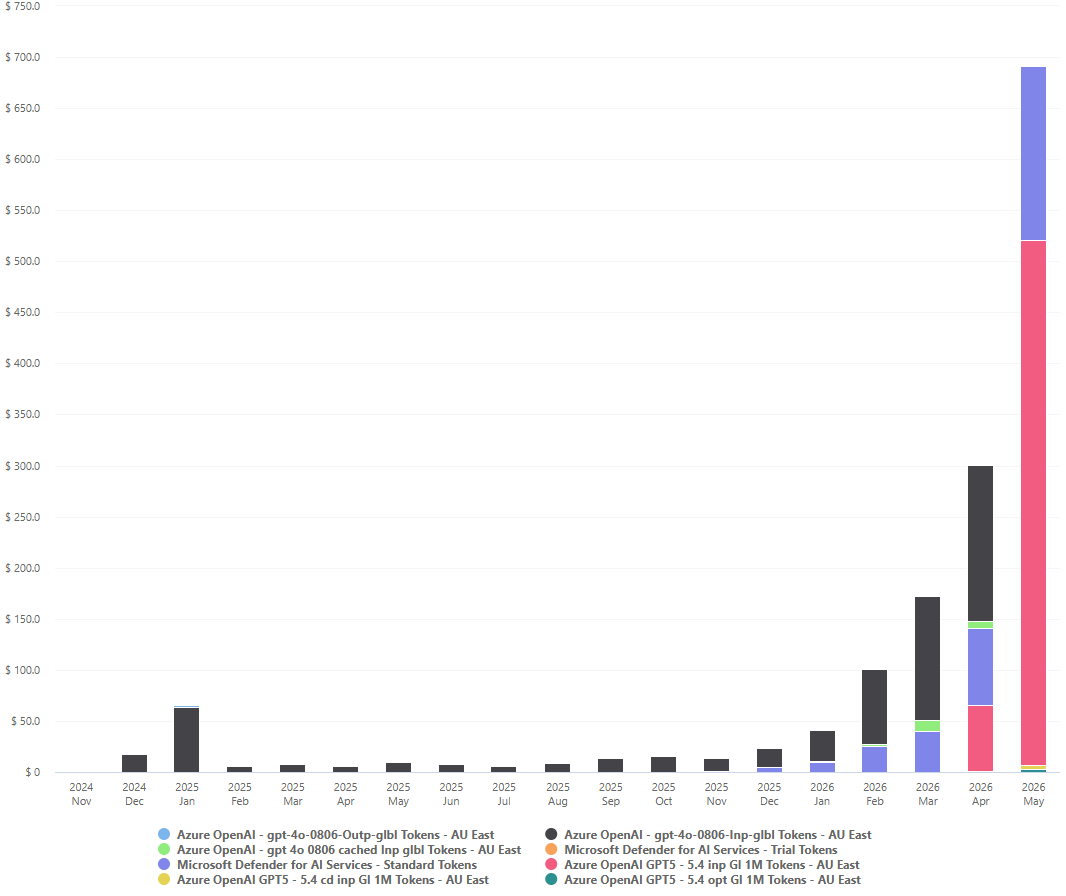
Why an Agentic AI Interaction Costs 30 Times More Than It Did in 2023
The cost of a single agentic interaction, the kind that involves tool use, reasoning, and iterative loops, has climbed to around $1.20, according to EY’s June 2026 analysis. That’s roughly 30 times higher than the $0.04 it cost in 2023.
Here’s the math that trips up anyone still budgeting off last year’s per-token rate. A chatbot answer typically touches a model once. An agentic workflow touches it repeatedly: once to plan the task, again for each tool call, again to check its own work, and again if the first attempt doesn’t land. Each touch is individually cheaper than it used to be. There are just far more of them per task, and the multiplication wins every time.
That’s why agentic workflows consume five to thirty times more tokens per task than a standard chatbot query. Growing context windows make it worse. As an agent handles longer, more open-ended assignments, it carries more conversation history and more retrieved documents, and that context gets re-read at nearly every step. The same growth that makes an agent more capable also makes every later action inside that task more expensive than the one before it.
The Cloud FinOps Playbook Already Covered This
Cloud computing went through a version of this same story, just spread over a longer timeline. The price of a unit of compute fell steadily for more than a decade, and enterprise cloud bills kept climbing anyway, because usage grew faster than the price dropped. The lesson wasn’t “wait for prices to fall further.” It was “build the visibility to see usage growth before the invoice does.”
The procurement mistake is already repeating too. Teams are signing annual token or compute commitments based on pilot-stage usage, the same way early cloud adopters signed reserved-instance contracts off a proof of concept that never resembled production load. A pilot for a handful of users rarely predicts usage once an agent rolls out company-wide.
Why Enterprises Keep Blowing Through Their AI Budgets
According to FinOps Foundation research, 73% of enterprises are exceeding their AI spend plans. Gartner forecast in mid-2025 that more than 40% of agentic AI projects would be canceled by the end of 2027. The technology wasn’t the reason. Nobody governed the cost of it early enough. That prediction is now roughly halfway through its runway, and nothing this year suggests it was wrong.
A canceled project isn’t a clean stop. It carries sunk engineering time, a process that has to be unwound back to whatever it replaced, and a harder internal case for the next AI proposal. It also carries a trust cost: the team that champions a rollout usually isn’t the one explaining the overrun once finance notices, and a function burned once tends to tighten scrutiny on every AI request that follows, including the good ones.
Part of the problem is timing. Finance plans in annual and quarterly cycles. Agentic usage compounds monthly, sometimes weekly, as teams find new uses for an agent approved for something narrower. By the time a variance shows up on a report finance reviews, months of drift can already be baked in. That drift isn’t hidden on purpose. The systems built to catch overspend were built around cloud’s rhythm of monthly invoices, not a workload that can double inside a single sprint.
Ask who’s supposed to catch a usage spike before it becomes a budget line, and at most companies the honest answer is nobody in particular. Engineering isn’t watching the bill. Finance is watching it a month behind, without the context to know if a spike is a problem or a use case worth funding further. Closing that gap takes clear ownership as much as better tooling.
Most organizations are managing AI spend the way they managed cloud spend a decade ago: reactively, after the invoice arrives. Yarken connects AI spend to the value it produces across every dollar it touches, so the invoice is never the first time anyone finds out what a workload really cost.